My work can be grouped into 3 categories: Strategic Design, Product Design, and work with Technology. As these largely overlap the majority of my project fall into multiple of these categories and all feature a technological aspect.
Dynamic Population Tracking


This project aims at mapping the daily population distribution within a city, and does so by reducing the amount of data required.
The system was design for the purpose of dynamic ambulance distribution. Currently ambulances are dispatched from stationary substations and response times are significantly longer then the desired 8 minutes.
This system allows for an optimised ambulance distribution based on where people actually are at a given moment, allowing to reduce response times.
This project was performed for Intel UK.

Concept Development
As a starting point to this project, I investigated what existing infrastructure can be used to track the population distribution within a city. As there is a problem with the ever growing amounts of data and its management, the goal was to develop a system that does not count each person as a data point, but rather takes into account concentrations of people as single data points.
The solution is to use the smartphones constant search for wireless networks. A generated, non-existent, wireless network can detect access requests in a certain area, and log them. As such a system travels, mounted to a car, it periodically collects a series of data points, which consist of a coordinate, as well as the number of detected wireless devices in the vicinity.
Such a system can be mounted on existing vehicles which consistently travel along arbitrary routes, such as taxis or police cars. The location of each data-points are paired with GPS coordinates, and are constantly updated as a different vehicle with a tracker enters the vicinity of the previously recorded coordinates.
System

The system consists of three components, an Intel Edison board, a pirate box, and a GPS unit.
A pirate box is a router modified to scan for access points as opposed to generating actual wifi networks.
For this project, the router was reprogrammed to generate an inexistent wifi network, and collected the MAC address of every device that attempted to connect to it.
As every wifi enabled device, such as a smartphone, constantly scans for networks to connect to, the modified router enables the listing of every phone within the vicinity of its network.


The GPS unit marks the geographical location of each data reading. The intel Edison then pairs this data into data points, and is capable of sending them to an online interface. Every new data point is collected once the GPS unit detects that the system has left the range of detection of the previous data point.
After a certain duration, the points expire and can be replaced by new ones, to ensure that the system remains dynamic.
Testing
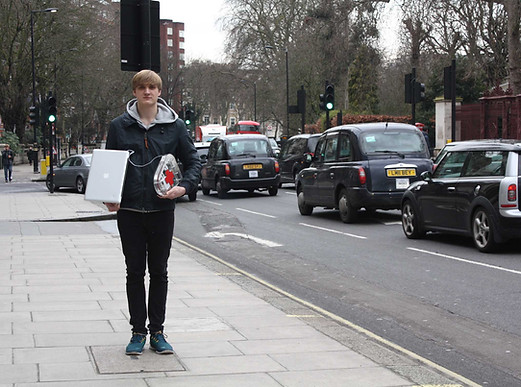
The system was tested around the Kensington region, which enabled the generation of the visualisation below. The diameter of the dots represents the amount of people detected.
The system was designed for the purposes of a dynamic distribution of ambulances, but the end product has a much higher value for the purposes of guerrilla population distribution tracking, when such task is needed.


As the initial prototype used for testing was large and bulky, the system can be scaled down. Such small scale devices can then be easily attached to existing infrastructure such as taxi cabs, bicycles, or even worn by people.
